EPBD changes the rules of the game
For more than eight years, Interlight and Ingy have worked together to develop smart lighting and building management systems. This collaboration forms the basis of Interlight Thinq, delivering innovative solutions that emerge from practical experience and customer needs. With the advent of the European EPBD IV directive, smart data is becoming more important than ever. In this article, we show how Interlight Thinq, thanks to extensive sensor data, can play a central role in future-proofing buildings.
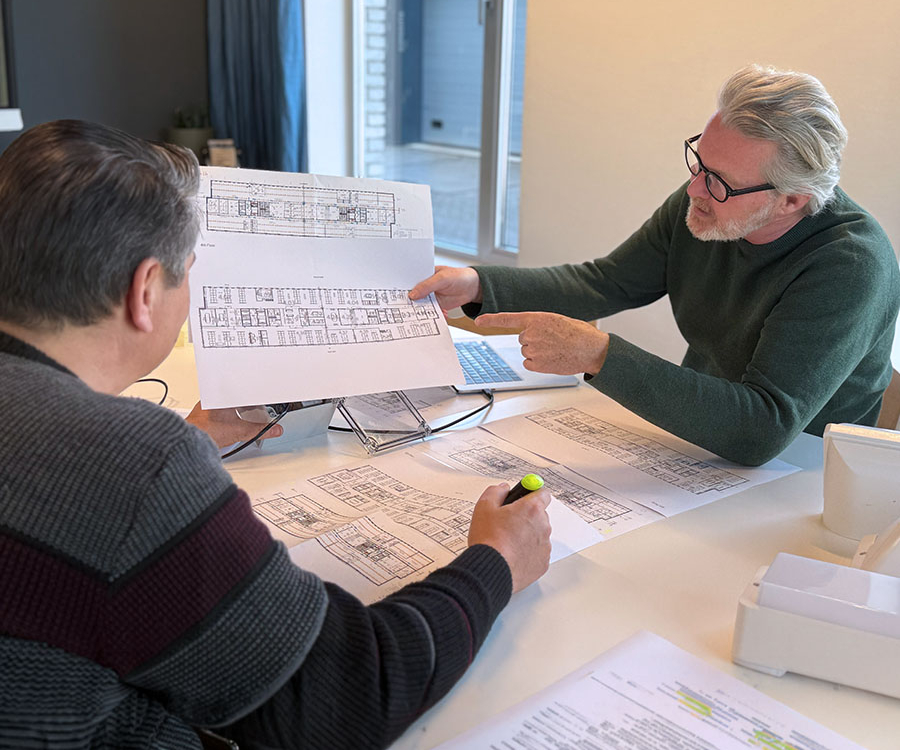
EPBD IV, it’s coming fast
The European Energy Performance of Buildings Directive (EPBD IV) changes the rules of the game for building owners and introduces an important obligation around building automation: the use of so-called Building Automation and Control Systems (GACS). These systems must continuously monitor the energy use of buildings, optimize performance, detect deviations and automatically adjust installations such as ventilation to actual occupancy. The goal is to not only design buildings to be energy efficient, but also to operate smartly and efficiently during daily use. In practice, this means that buildings are becoming increasingly dependent on reliable sensor data to actively manage comfort, energy consumption and air quality.
2030!
The GACS requirement is being phased in and applies in particular to non-residential buildings such as offices, schools, healthcare facilities and other non-residential buildings with larger technical installations. Starting in 2026, buildings with heating or cooling systems with a capacity greater than 290 kW must have one. From 2030, this limit will be lowered to 70 kW, bringing a much broader group of existing and new utility buildings under the obligation. This creates a clear shift toward smart, data-driven buildings in which monitoring and automation play a central role.
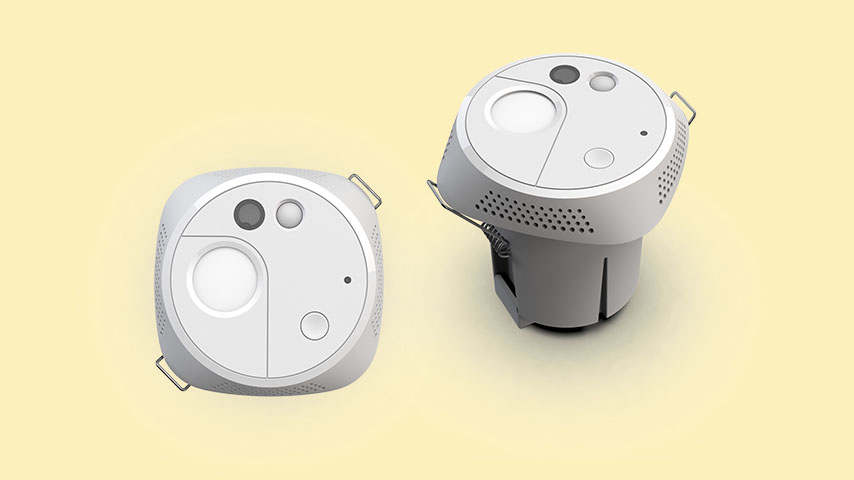
The Thinq Mira all-in-one sensor
Thinq Mira all-in-one sensor
From this impending change in legislation, the idea for the new Thinq Mira all-in-one sensor was also born. By realizing projects, having conversations with smart building professionals and keeping up with the latest European regulations, the idea for this sensor was born. The Interlight Thinq Mira sensor delivers all the data required to provide a GACS system with the right measurements. Air quality, attendance, people counting, temperature, and much more. And in the process, of course, the sensor remains the foundation for wireless light management
Solutions
Another great example is a custom solution within one of our Thinq projects. Within one of our ongoing projects, our client wanted time-controlled lighting control under his solar carport. An outdoor setup where we placed our Thinq waterproof fixtures. In addition, a compact IP65 installation box with DIN rail, in which we placed an astro switch box from Paladin, combined with an Interlight Thinq T4 input.
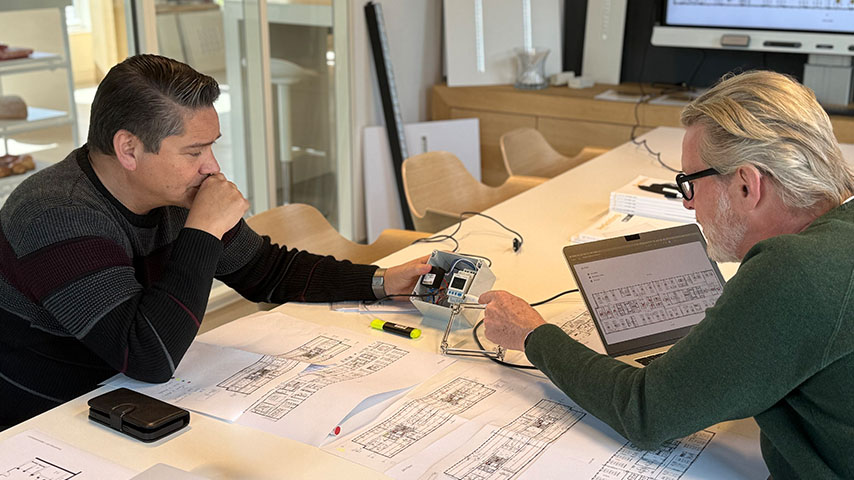
Michel (Jacs Koopman) and Sytze (Ingy) talking about the IL-T4INPUT
The IL-T4INPUT is a compact recessed module with four switching scenes. This makes it possible to program a total of 4 different scenes from the time switch (or, for example, a normal wall switch) and to send this signal wirelessly to all wirelessly linked fixtures. No control lines, the fixtures only need to be connected with 230V power supply. Maximum flexibility and enormous savings on hours and material.
As of 2030
- Utility buildings with installations >70kW must have GACs (Building Automation and Control System)
- Minimum energy performance requirements (MEP) for existing buildings take effect.
- All new utility buildings must be built zero-emission (Zero-Emission Building – ZEB)
